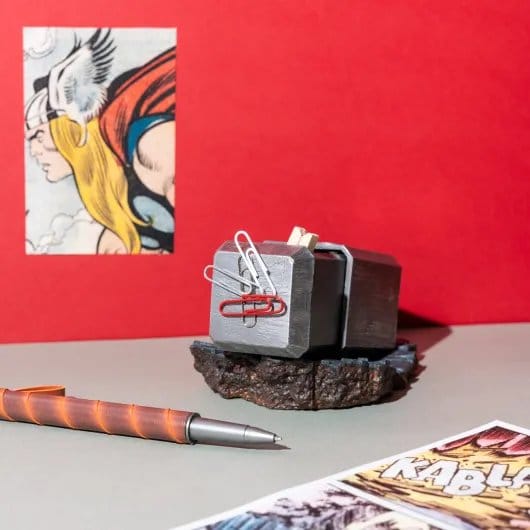
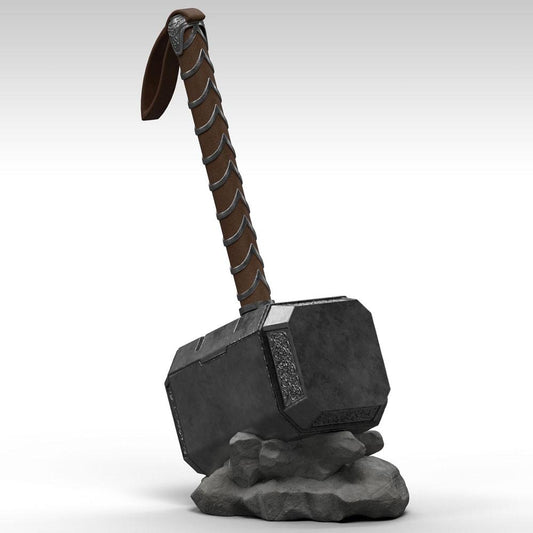
Thor Merchandise
Are you worthy?
Mythology has always been a popular source of inspiration for fiction. Dante Alighieri and William Shakespeare were already incorporating numerous characters and motifs from it. Then came Tolkien, who gathered all sorts of myths and legends to create his own monumental myth. In modern fiction, we have series like Supernatural or Ragnarök, films like Clash of the Titans, Valhalla, or Gods of Egypt, books like the Percy Jackson series and other novels by Rick Riordan, and gaming series like God of War and Assassin's Creed. Stargate and Indiana Jones and the Kingdom of the Crystal Skull then took up theories of ancient astronauts—popularized primarily by Erich von Däniken—and linked ancient gods with extraterrestrials. Erich von Däniken? What is he actually doing these days? Nowadays, he's probably watching videos by Attila Hildmann and Xavier Naidoo, thinking: "Wow, that's just too crazy for me." The Nordic thunder god Thor is also turned into an alien in the Marvel Cinematic Universe, but that wasn't always the case. In the Marvel comics, Asgard is—as in mythology—one of the nine realms of the world tree Yggdrasil, which can be compared more to other dimensions than planets. Overall, the comics are closer to the mythological source material than the films. For instance, Thor is the son of Odin and Fjörgyn/Jörd here, not Frigga/Frigg. By the way, in Germanic mythology, which differs from the Nordic only in its names, the thunder god is called Donar. That it is not a long way from there to "Donner" (thunder) is something not only linguists recognize.
Stan Lee said regarding the development of the character:
"How do you make someone stronger than the strongest person? It finally came to me: Don't make him human — make him a god. I decided that the readers were already pretty familiar with Greek and Roman gods. It might be fun to delve into the old Norse legends. [...] Besides, I imagined the Norse gods like the Vikings of old, with flowing beards, horned helmets, and battle clubs."
Thor made his debut in 1962 in Journey into Mystery #83 and, just a year later, fought alongside superheroes Ant-Man, the Wasp, Iron Man, and the Hulk as the newly formed Avengers against his brother Loki. In the comic, too, Thor was initially banished to Earth by Odin until he proves himself worthy of Mjölnir. However, in the comics, he initially has no idea who he is. He suffers from amnesia and thinks he is the disabled physician Dr. Don Blake. Jane Foster is actually his assistant here, not an astrophysicist who looks like Darth Vader's wife. Speaking of which: the MCU and Star Wars both belong to Disney. Crossover idea: Darth Vader finds out that Thor took off with his girlfriend. Mjölnir vs. lightsaber and the Force. Don't tell me you wouldn't want to see that. In the comic, at least, Mjölnir, disguised as a cane, falls into the hands of Dr. Don Blake, and he remembers.
In Kenneth Branagh's film, this origin story is alluded to, but essentially skipped. Here, the god of thunder returns home to Asgard despite his love for Jane, whereas his comic counterpart remains on Earth (or Midgard), for which Odin will later punish him again. Because in the comics, it wasn't his son's immaturity that caused Odin to banish him, but his repeated interference in Midgard, which the All-Father had forbidden.
In the comics, Thor's enemies and allies don't just come from the Norse pantheon. For example, the thunder god saves Hercules from Pluto. No, not the dwarf planet. And not Mickey Mouse's dog. We are talking about the Roman god of the underworld, known to the Greeks as Hades. Conversely, this does not mean that Loki, Malekith, Laufey, Hela, Surtur, Odin, Sif, Heimdall, Balder, Frigga, Tyr, Valkyrie, Enchantress, or Freya aren't a common sight in the Thor comics. In any case, they open up a whole new world for the Marvel Universe.
Let's talk briefly about Mjölnir and those who can lift it. In Avengers: Endgame, we see Captain America wielding the hammer. So Cap is worthy, but he doesn't take Thor's place. In the comics, other superheroes did. The most well-known example would probably be Beta Ray Bill. Other versions of the thunder god in Marvel's main continuity include Red Norvell and Eric Masterson. But the biggest stir occurred when Marvel announced the first female Thor in 2014 and placed Mjölnir in Jane Foster's hands. This storyline is meant to be picked up by Thor: Love & Thunder in Phase 4 of the MCU. And Padmé, i.e., Natalie Portman, has muscles now. What else awaits us in upcoming films, now that the Multiverse has opened the door to all sorts of variants, is something we can at best speculate about.
Now the question is: Are you worthy of the cool merchandise in our online shop? Can you lift our mugs, smash them on the ground, and demand more of the delicious brew? And yes, feel free to throw the mugs; then you'll need new ones. Planned obsolescence works well for electrical appliances, but not so well for posters and clothing. We only have lamps on offer, though they are probably more decoration than electrical appliances. Does Mjölnir actually count as an electrical appliance? Does Nidavellir offer a two-year warranty on it? Considering how long the thing lasts, that's not a good business model either. The yvolve shop's business model is primarily to make nerds and geeks happy; money is secondary. Why don't we just give away all the merch as gifts? Then we wouldn't have the money to buy fan items like T-shirts, caps, and bags ourselves. That's just how capitalism works. Even Karl Marx would be tempted by our cool accessories for film fans and series junkies. How much more fun would it have been to write down Das Kapital in one of our beautiful notebooks? Maybe instead of "Workers of the world, unite!", it would have been "Avengers assemble!" Though the other way around would be funny too, and with the way the timelines are being played with in Marvel now, it's absolutely conceivable.